
Haywood County Court Records After Arrest
After an arrest in Haywood County, two records tracks can exist at the same time. The Haywood County Detention Center record is a custody record. It can identify the person in jail, the booking charges, the bond amount, and residential or housing information available through the sheriff's inmate-information phone line. The court record is different. It belongs to the criminal case and shows the case number, filed charges, hearings, attorney information, bond orders, motions, pleas, dispositions, sentences, and court costs.
That split matters because jail charges are not always the final court charges. Law enforcement may arrest on one set of alleged offenses, then the District Attorney may file, amend, reduce, dismiss, or pursue different charges after reviewing evidence and North Carolina law. Custody and booking details fit more naturally with Haywood County jail inmate records, while booking photos belong with Haywood County jail mugshots. Court records after a jail arrest are the best source for the formal charge path and the outcome of the case.
Search Haywood County Court Records
Haywood County is in North Carolina Prosecutorial District 43, Superior Court District 43B, and District Court District 43. Public court searches start with the NC Judicial Branch Haywood County page, the court-date search tools, and the North Carolina eCourts Portal. The Portal can show public case information, hearings, and payment-related information for public cases. Anonymous public users can search public information, while registration mainly helps users save cases and does not unlock restricted records.
- Start with custody if the arrest is recent. Call the Haywood County Detention Center inmate line at (828) 452-6670 and select option 1 for charges, bond amounts, and residential information.
- Search the Judicial Branch court-date tool by name, citation number, county, or other listed fields when the next hearing is the main need.
- Use the eCourts Portal for broader case search. Try the full name first, then use the Portal wildcard rules if spelling or initials are uncertain.
- Filter to Haywood County when possible. Municipal arrests from Waynesville, Canton, Maggie Valley, or Clyde can still produce a Haywood County court case.
- Open the case and compare each filed charge with the jail booking charge, bond order, next hearing, disposition, and financial entries.
- For older files, missing online results, certified copies, or paper case records, contact the Clerk of Superior Court at the Haywood County Courthouse.
The Haywood County Courthouse is at 285 N. Main Street, Suite 1500, Waynesville, NC 28786. The clerk phone is (828) 454-6501, and courthouse hours are Monday-Friday, 8 a.m.-5 p.m. The North Carolina Judicial Branch says criminal case information may be accessed through public self-service terminals in clerk offices, through Portal where available, and through paper files at the clerk in the county where the case is located.
| Search Field | Use | Notes |
|---|---|---|
| Portal Smart Search | Name, case number, citation, or related search term | Use exact terms first, then try partial search if needed. |
| Court Dates | Name, citation number, county, and more | Best for hearing dates tied to Haywood County court. |
| Search Hearings | Case number, party, business, attorney, judicial officer, or courtroom | Useful when the next court event is known but the full case is not. |
| Wildcard Search | Partial case, business, nickname, or name entries | Portal training gives minimum character rules before adding an asterisk. |
| County Filter | Limits statewide results | Choose Haywood County when the arrest or prosecution is local. |
| Elevated Access | Restricted or non-public data | Requires verified statutory or business need, not ordinary public browsing. |
The NC eCourts Portal is the public online channel for many case searches and hearings.
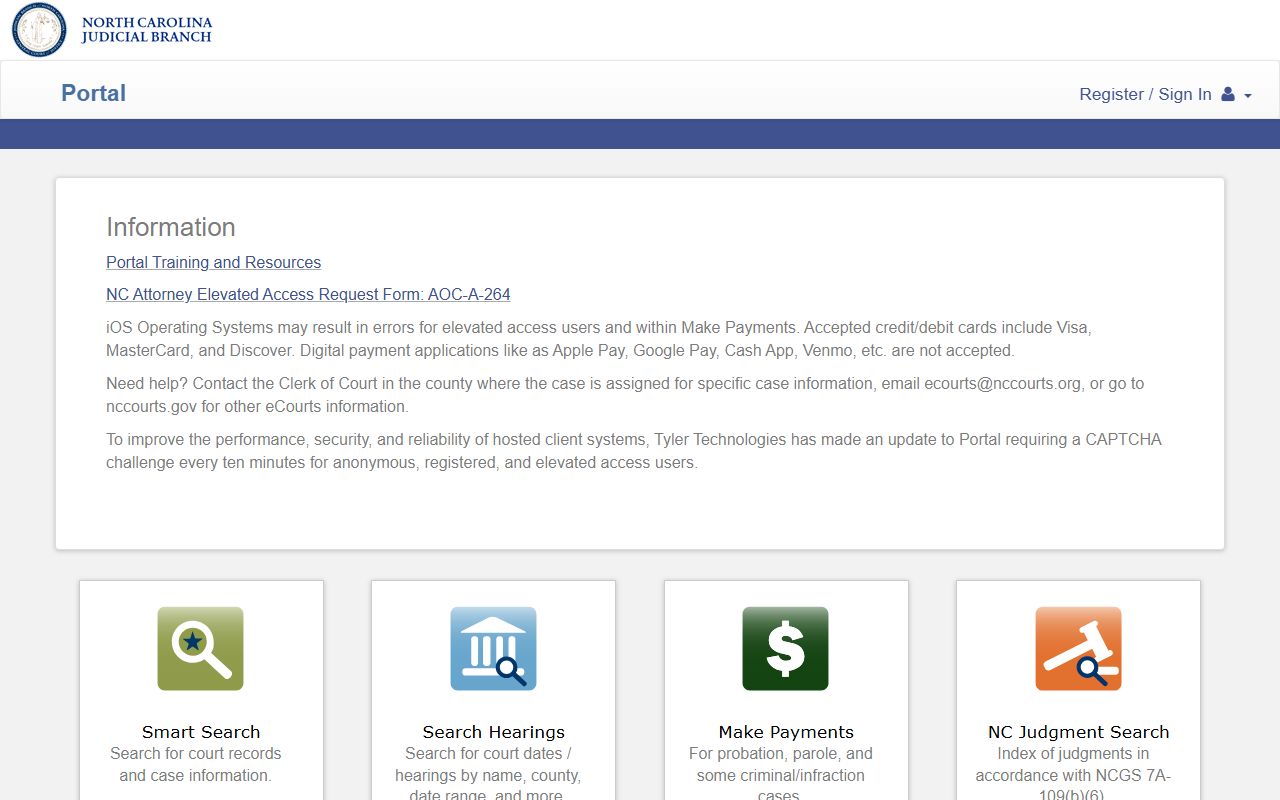
The Portal is useful for court records and hearing data, but it should be checked against the jail phone line when the question is current custody or bond.
Haywood Court Charging Documents
A criminal case begins with a charging instrument, but the form can vary by offense and stage. A complaint, citation, warrant, information, or indictment may appear before or during prosecution. In plain terms, the document states what offense is alleged and gives the court a file to manage. In Haywood County court records after arrest, a later filing may replace or refine what first appeared during booking at the jail.
| Document | Who Uses It | What It Means |
|---|---|---|
| Complaint, citation, or warrant | Law enforcement, magistrate, or court process | Often appears early and can support arrest, booking, or an initial court case. |
| Information | Prosecutor | A prosecutor-filed charging document used in some criminal contexts. |
| Indictment | Grand jury | A formal charging document often tied to felony-level proceedings. |
North Carolina court records may also show amended charges. An amendment means details changed. A reduction means the charge moved to a less serious offense. A dismissal means that charge ended without a conviction. These entries should be read charge by charge, because one case can include several counts with different results.
Haywood County Arrest Prosecution
The prosecutor for Haywood County is District Attorney Ashley Hornsby Welch. The North Carolina Conference of District Attorneys lists her for Prosecutorial District 43, which covers Cherokee, Clay, Graham, Haywood, Jackson, Macon, and Swain counties, with the district phone listed as (828) 349-7210. The District Attorney's Office is the prosecution side of a criminal case after arrest. Officers initiate arrests and charges, but prosecutors decide how to handle many filed charges in District or Superior Court.
For victims, the Haywood sheriff FAQ says victim assistance can be requested from the District Attorney's Office at (828) 454-6510. It also lists a sheriff's domestic-violence and sexual-assault victim advocate during weekday business hours. NC VINE, also known as NC SAVAN, can provide custody and case-related notifications by phone, email, text, or TTY for included custody or supervision statuses.
Note: A prosecutor's charging decision can change the court record even when the jail booking entry has not changed.
Haywood Court Charge Status
Charge status is the live condition of each count in the court case. A charge can remain pending while the case is open, then end through dismissal, plea, trial verdict, deferred process, or another disposition. A single arrest can lead to more than one charge, and each charge can move on its own track. That is why a Haywood County court records search should not stop at the first charge label.
| Status | Plain-English Meaning | Reader Check |
|---|---|---|
| Pending | The charge remains open and has not reached a final disposition. | Check the next court date and bond order. |
| Amended | The charge details changed after the original filing. | Compare the current count with the first booking or citation language. |
| Reduced | The prosecutor or court changed the charge to a less serious offense. | Read the final offense, not just the arrest offense. |
| Dismissed | The charge ended without conviction on that count. | Look for other counts in the same case before assuming the case is over. |
| Disposition | The final result, such as guilty, not guilty, dismissed, deferred, or another outcome. | Use the disposition date and charge-specific result. |
Bond Orders After Arrest
Bond in Haywood County is set after an arrested person is brought before a judge or magistrate. The sheriff's detention page says the judicial official sets the Conditions of Release and bond, and those conditions must be met before release before the court date. North Carolina G.S. 15A-534 governs the procedure for determining pretrial release conditions, while G.S. 15A-533 addresses the right to pretrial release and exceptions.
For a secured bond, Haywood lists cash bond, property bond, and bondsman or surety options. A cash bond is paid in full to the Clerk of Superior Court. A property bond can involve Haywood County land and may require a current tax statement when the bond is greater than $2,500 unless waived. A bondsman may post a surety bond, but detention staff cannot recommend a bonding agency. Personal recognizance and unsecured release are state-law release paths, but availability is case-specific.
A hold can keep a person in custody even when money is available. Holds may stem from another county warrant, probation or parole matters, federal or immigration detainers, a domestic-violence release restriction, a child-support order, or a judge's no-bond order. Confirm current custody and bond through the HCSO inmate-information line at (828) 452-6670 option 1 before relying on a court entry alone.
Haywood Arrest Warrants
No complete official Haywood County active-warrant search database was located in the research. The sheriff publishes a Most Wanted / On The Run page, but that page is a public-safety feature rather than a full warrant list. An outstanding warrant can still lead to arrest, booking at the Haywood County Detention Center, bond review, and then a court case that appears in public court records.
The sheriff FAQ gives a local route for people seeking a misdemeanor warrant for assault, trespassing, communicating threats, harassing phone calls, or another misdemeanor matter: go to the Magistrate's Office at the Law Enforcement Center, 1620 Brown Avenue, Waynesville. For court failures to appear, the Clerk of Superior Court and the eCourts Portal are better records channels. A bench warrant or order for arrest often links back to a missed court event, not a new incident report.
Charges and Convictions
An arrest charge is an accusation, not a finding of guilt. A conviction happens only after a guilty plea, guilty verdict, or other adjudication that creates legal guilt on a charge. The difference is central when reading Haywood County court records after a jail arrest, because many cases include dismissed, amended, or reduced charges alongside charges that end another way.
Charge
A charge states an alleged offense. It may begin with arrest paperwork, a warrant, citation, complaint, information, or indictment. It can be pending, changed, or dismissed.
Conviction
A conviction is a final guilt result on a charge. It may follow a plea or trial verdict and can lead to sentence, probation, jail credit, fines, or costs.
Background checks should be handled with care. The sheriff FAQ says a Haywood County criminal records or background check can be obtained from the Clerk of Superior Court in the Haywood County Justice Center for $25. The Judicial Branch also cautions that background checks should use the county clerk's office rather than treating Portal as a full background-check system.
Sealed and Expunged Records
Restricted records are not the same as ordinary public search results. Juvenile matters, sealed files, expunged records, certain victim data, confidential law-enforcement material, and restricted access case information may not be available to anonymous public users. North Carolina G.S. 15A-146 covers expunction after dismissal or a not-guilty finding, and G.S. 15A-151 makes expunged court records confidential.
Sealed
A sealed record is hidden from ordinary public view but may still exist for limited users or court-approved access. The public Portal may not display it.
Expunged
An expunged record is treated as confidential under the expunction order. Public court access should not be used to recover it.
G.S. 132-1 broadly defines North Carolina public records, but G.S. 132-1.4 treats criminal investigation and intelligence records differently. Basic arrest information may be public, while full investigative files can be withheld, redacted, or routed through a specific records process. For HCSO records, use the Haywood County Sheriff's Office public records request form and describe the record clearly.
Restricted Haywood Court Records
Some court records after an arrest will not appear in a public online search. Restricted records can include juvenile cases, sealed matters, expunged records, confidential victim information, mental-health or treatment material, and non-public information tied to active investigations or statutory privacy rules. Portal training also distinguishes ordinary public access from elevated access, which is reserved for verified users with a legal or business basis.
When a public search produces no result, do not assume no arrest or case exists. The case may be too new, filed under a different spelling, tied to a citation number, restricted, pending clerk entry, or located in another county. For public case records, contact the Haywood County Clerk of Superior Court. For jail custody, charges, bond amounts, and residential information, use the HCSO inmate-information phone line. For state prison or community-supervision records, use the North Carolina Department of Adult Correction instead of the county jail or clerk.
Important: Haywood County Inmate Population is not a consumer reporting agency, and its information may not be used for FCRA-covered decisions.